
Personalization works best when it moves with the moment. The most common missed opportunity isn't personalizing too aggressively, nor is it ignoring what is already known about someone. Rather, systems simply miss when to ease off, because they were built to treat "how personalized should this response be" as a setting decided once, rather than an ongoing calibration.
Most AI systems treat personalization as a switch: either the model uses what it knows about you, or it doesn't. That binary framing hides the real design challenge. The question was never simply whether to personalize; it is how much weight historical context deserves in this specific moment compared to what the user is signaling right now.
Picture someone whose history says they prefer long, detailed explanations, established clearly across enough past sessions to count as real evidence. Today, their messages are three words long, and they've asked the same direct question twice, obviously in a hurry. A system running with personalization fixed "on" will default to the usual multi-paragraph answer anyway, completely missing the immediate context.
Here is how that exact moment looks when handled two different ways:
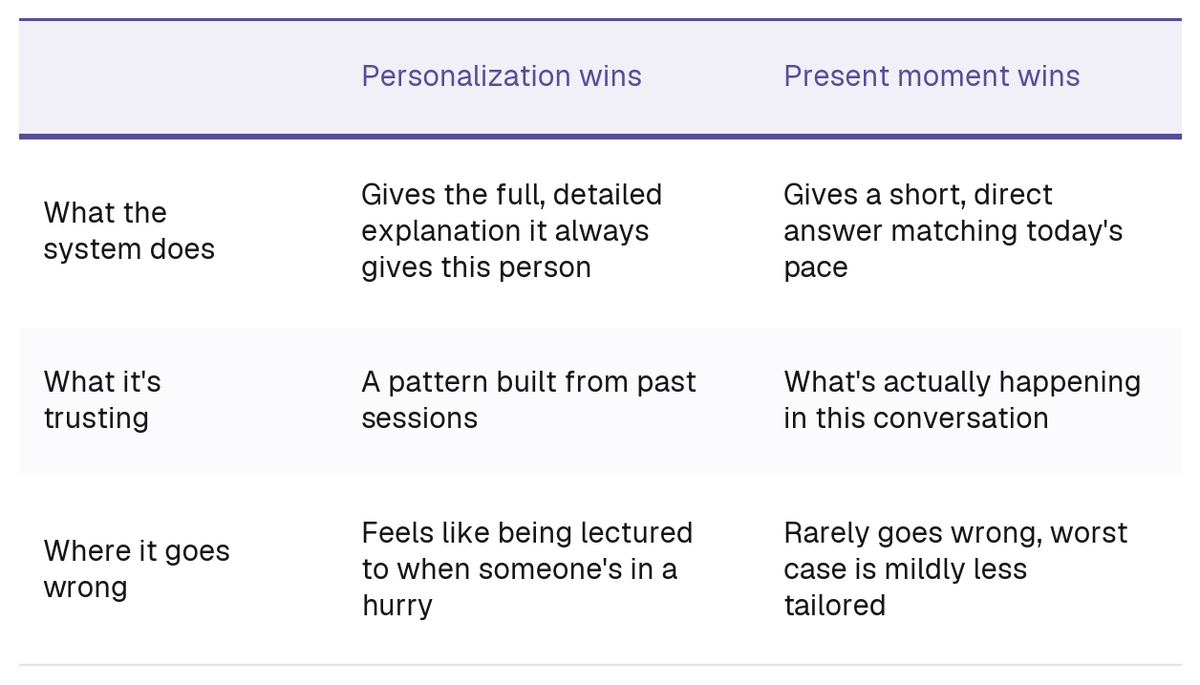
The asymmetry in that bottom row matters more than it looks. Getting this wrong by ignoring history costs a slightly generic answer. Getting it wrong by insisting on history costs an answer that actively fights the moment the person is actually in, and it does so with confidence, because the history behind it was genuinely strong. That's the failure mode exactly: not weak personalization, overconfident personalization, applied at precisely the moment it stopped being warranted.
The obvious fix is to have the system notice when the present moment disagrees with what it thinks it knows, and respond to the present instead. That's true, but it only solves half the problem, because it treats the disagreement as a single, isolated event. Real conversations aren't single events. A person can send one uncharacteristically short message and still, on the whole, be the same person their history describes. The harder question isn't whether this one message disagrees with history, it's how many times in a row it's disagreed, and what that should do to how much the system trusts its own read of this person going forward.
Most systems leave that question open. They tend to hold personalization steady regardless of how many signals point in another direction, until an internal threshold is reached and they shift all at once. But that isn't quite how trust naturally moves. It works better when it eases off the moment disagreement starts, and keeps declining smoothly as more of it accumulates, rather than staying confidently wrong through an entire stretch and then overcorrecting in one step.
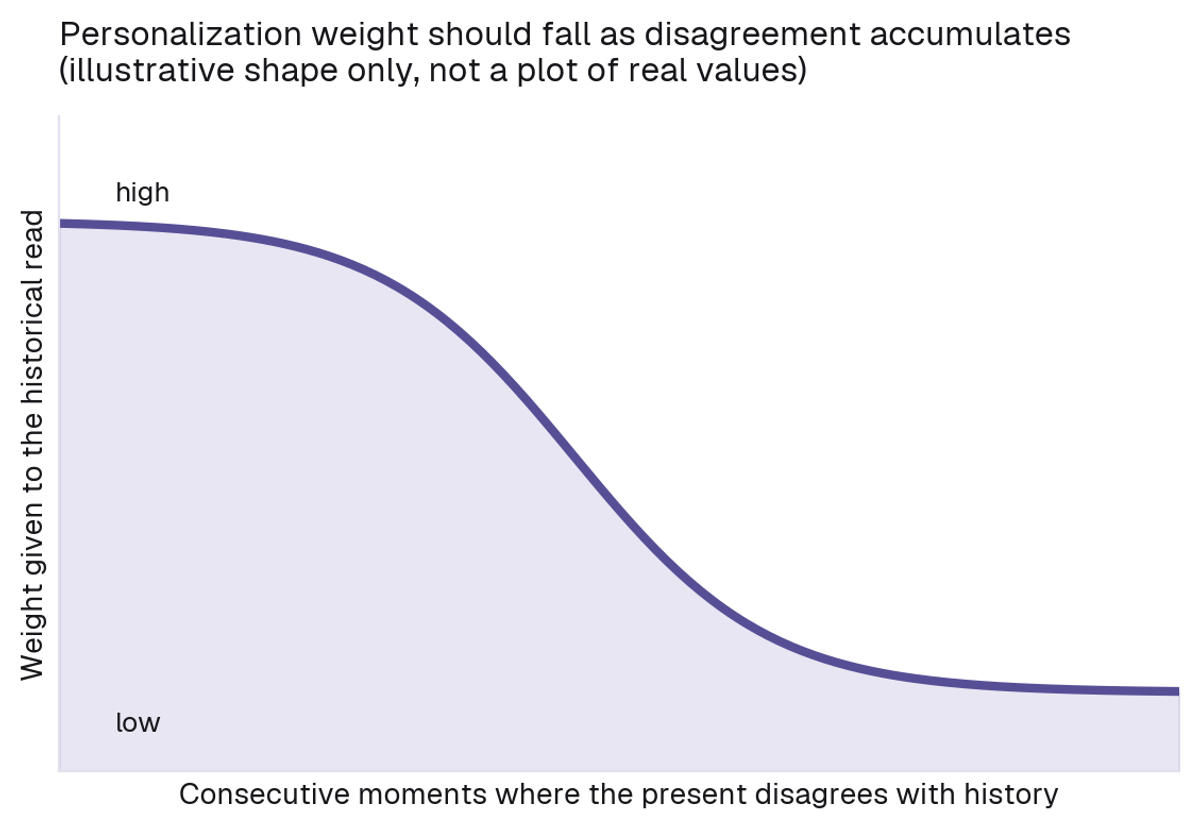
The better shape is a gradual one. Trust in a historical pattern should start easing the moment disagreement shows up, and keep easing the longer that disagreement continues, rather than holding firm and dropping all at once.
The two ways of getting this wrong aren't equally costly. Backing off too soon on what turns out to be a one-off risks nothing more than a slightly more neutral response. Staying confident too long through a real, sustained pattern of disagreement risks a system that keeps getting the same person wrong at exactly the moment it most needed to notice something had changed.
Recovery should move slower than decline. If trust in a pattern has been sliding for three turns in a row, one turn of agreement shouldn't be enough to restore it to full strength. A pattern that took a real hit to its credibility should have to rebuild that credibility gradually, the same way it was never entitled to apply unconditionally in the first place.
None of this needs to be vague to implement. What history means here is a count and consistency check across past instances, not a general impression of familiarity. What disagreement means is a live comparison between the current turn and what that history would have predicted.
Treat personalization the way this scenario actually demands: not as a hard on-or-off setting decided once and applied uniformly, but as a live, moving weight, one that responds to a single moment when it has to, and to a whole pattern of moments when it should.